
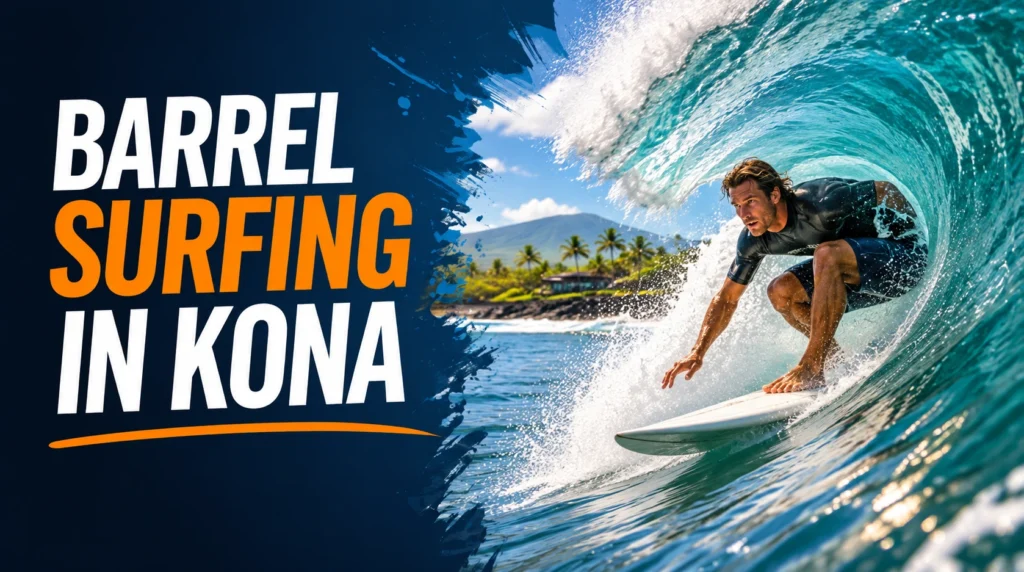
Every surfer remembers the first time they watched a surfer in barrel position, crouched low with the lip throwing over their head, eyes fixed on the small opening ahead. From the beach, it looks calm and almost easy. In the water, it asks for speed, timing, and a level of composure that only builds through repetition. The good news is that every piece of it can be trained.
Surfing in Kona has a character all its own. The Big Island’s leeward coast is sunny and often glassy in the mornings, with warm water and reef bottoms that shape clean, powerful waves when a swell arrives. That combination makes it a rewarding place to study how a wave actually breaks, which is the first step toward riding inside one.
Why Barrel Surfing Rewards Patience and Precision
Barrel surfing is less about bravery than about preparation. The surfers who make it look easy have usually spent hundreds of sessions learning where to sit, how to read a wave before it stands up, and how to generate speed without forcing the board. Courage matters, but it only helps once the fundamentals are in place.
The Fundamentals of Barrel Surfing
The foundation of barrel surfing is a late, committed takeoff. Instead of dropping in early and racing the wave, you angle slightly toward the pocket and let the face steepen beneath you. From there, a low, compact stance keeps your center of gravity stable while the wave moves over you. Tube surfing demands that you stay relaxed under pressure, because a stiff body fights the board instead of guiding it.
Your eyes matter just as much as your feet. Look down the line toward the exit rather than at the lip above you. The board tends to follow your gaze, and keeping your attention on the opening helps you adjust speed instead of freezing.
How a Barreling Wave Forms Along the Kona Coast
A barreling wave appears when swell energy meets a bottom that rises quickly, forcing the face to jump upward and the lip to throw forward. Kona’s lava reef and relatively deep water close to shore can produce exactly that shape on the right swell, which is why surfing in Kona rewards anyone who takes time to watch the lineup before paddling out.
Watching is a skill in its own right. Notice where waves begin to peel, how fast the section is moving, and how the lip behaves at different tide levels. A barreling wave usually has a predictable rhythm, and the surfers who catch the best ones are rarely the ones paddling hardest. They are the ones who understand where the wave will stand up.
Wind and tide change the picture quickly. Light offshore breezes hold the face open and smooth, while a rising or dropping tide can turn a soft section into something hollow. Learning to match your session to those conditions is part of the craft.
Reading the Line Like a Surfer in Barrel Conditions
Positioning separates a surfer in barrel territory from someone who simply gets close. Sit slightly deeper than feels natural, and shift your position as the swell direction and tide change. If you always sit where the wave breaks softly, you will never reach the part that opens up.
Once on the wave, think in terms of line. Too high, and the lip lands on you. Too low, and you outrun the section and watch it close behind you. The correct line is a moving target, which is why a patient, observant surfer improves faster than someone chasing volume. Barrel surfing rewards reading more than reacting.
Skills Worth Drilling Before You Chase Bigger Waves
Advanced surfing starts with fundamentals practiced under pressure. Before you chase hollow reef waves, spend time on a few skills that translate directly into the tube.
- Speed generation. Pumping down the line builds the momentum you need to stay ahead of the section.
- Bottom turns. A smooth, committed bottom turn sets the angle that places you under the lip.
- Compact stance. Bend your knees, drop your chest, and keep your weight centered.
- Rail grab and stall. Touching the rail with your back hand slows you down so the wave can catch up.
- Exit speed. Practice driving out so you can finish the wave instead of getting caught behind it.
Even small improvements in these areas make barrel surfing feel less like a gamble and more like a repeatable skill. Many surfers find that tube surfing finally clicks once their basic technique stops requiring conscious thought.
Staying Safe on Shallow Reef
Reef breaks reward skill and punish mistakes, so safety is part of improving. Learn how to fall away from the board, protect your head, and stay calm during a hold-down. Wear a leash you trust, and check the depth of the reef at different tides before committing to a takeoff.
Advanced surfing also means knowing when to sit out. If the swell is bigger than your preparation, watching from the channel is a smart decision, not a failure. Respect for the ocean is what keeps you surfing for decades.
Getting Coaching on the Island
Feedback accelerates progress in a way that solo sessions cannot. Video review, a watchful eye from the beach, and guidance on wave selection can shave years off the learning curve. If you are ready to build a foundation, surf lessons Kona big island visitors rely on are a practical way to learn the fundamentals with someone who knows the breaks. For surfers who already ride confidently and want to sharpen specific skills, surf coaching Kona residents recommend can focus on takeoffs, positioning, and the technique behind barrel surfing.
Whether you are preparing for your first hollow wave or refining a skill you already have, steady practice and honest feedback will take you further than any shortcut. The tube is waiting, and with patience, it becomes something you plan for rather than something that happens to you.