
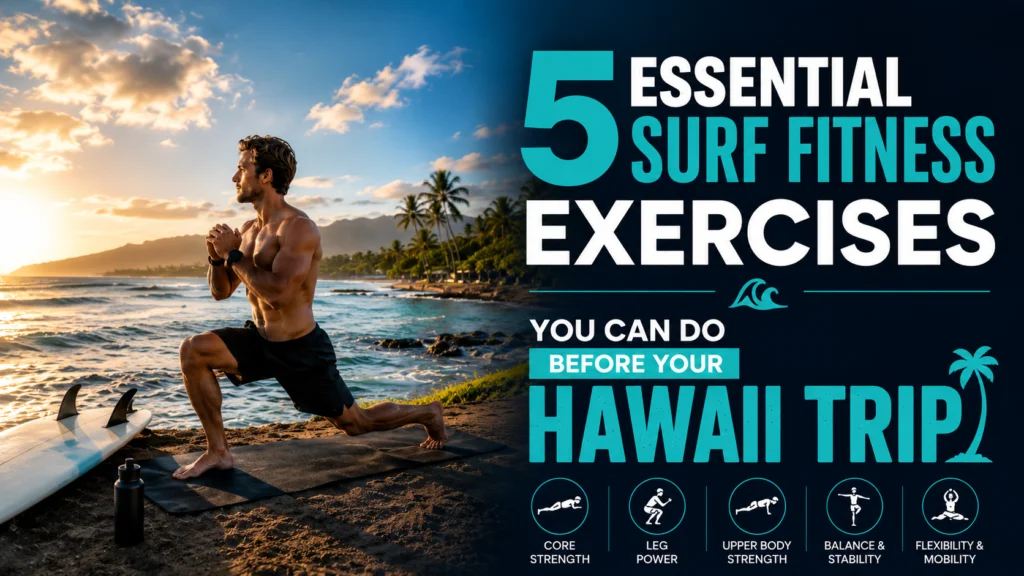
Most people book a surf trip and figure their body will sort itself out once they hit the water. It rarely does. Surfing fitness is specific. Paddling burns out your shoulders fast. Popping up to standing demands hip flexibility and explosive core strength. And staying low on a moving board for any length of time will find every weak point in your lower body.
A few weeks of targeted prep work before your Hawaii trip will make a real difference to how quickly you progress and how good you feel after each session.
Why Surfing Fitness Matters Before You Paddle Out
Most people underestimate how physically demanding surfing is until they are lying flat on their board after twenty minutes, wondering why their arms have stopped working. The paddling alone challenges muscles that rarely get hit in everyday movement or standard gym routines.
Arriving with even a baseline of surf-specific fitness means you spend less time recovering between waves and more time actually riding them. In Kona, where conditions are generally welcoming for newer surfers, being physically ready to make the most of good water is a genuine advantage.
Surfers Exercises: What Your Body Actually Needs
Surf exercises for fitness are not about being big or being fast in a straight line. It is about endurance through repetitive paddling, stability on an unstable surface, and the explosive hip drive required to pop up cleanly in a fraction of a second.
The five surfer exercises below address those specific demands. You do not need a gym membership to do most of them. A mat, some floor space, and a consistent schedule are enough to build meaningful surf fitness before your trip.
Surfing Exercises: The Core Five
1. Pop-Up Practice
The pop-up is the foundational movement of surfing, and it is one that most beginners underestimate. Start lying face down on your mat with your hands flat beside your chest, exactly where they would be on a surfboard. In one controlled movement, press up and bring both feet to a staggered surf stance simultaneously.
Practice this slowly at first to build muscle memory, then work toward faster, cleaner reps. Aim for three sets of ten with a focus on landing softly and consistently in the same foot position every time.
2. Prone Paddling Simulation
Lie face down on a stability ball or a padded surface and perform alternating arm pulls that mimic the freestyle paddle motion used in surfing. Keep your chest slightly raised and your core engaged throughout the movement.
If you have access to a pool, swimming freestyle for twenty to thirty minutes three times a week is arguably the best single cross-training activity for surfers. It builds paddle endurance, shoulder conditioning, and breath control simultaneously.
3. Single-Leg Balance Training
Balancing on a moving board requires your ankles, knees, and hips to make constant micro-adjustments. Single-leg standing exercises train exactly that chain of stabilizers. Stand on one leg for thirty to sixty seconds, progress to doing it with your eyes closed, and eventually add a wobble board or balance disc.
A balance board is worth investing in if you are serious about surf prep. Even ten minutes of daily practice on one will noticeably improve your stability on a real board in the water.
4. Surf Workout Routine: Putting It Together
Consistency matters more than intensity for a surf workout routine. A short daily routine beats one long session once a week by a significant margin. The following schedule works well for a four to six-week lead-up to your Hawaii trip.
Three to four days per week: Pop-up practice (3 sets of 10), prone paddling simulation (3 sets of 15 each arm), single-leg balance work (3 rounds of 45 seconds per side).
Two days per week: Pool swimming for 20 to 30 minutes at a moderate pace, focused on freestyle technique rather than speed.
Daily: Five minutes of hip flexor stretching and thoracic spine rotation. Surfing loads both of these areas heavily, and keeping them mobile protects you from the stiffness that builds up across multiple sessions.
5. Core Workouts for Better Surfboard Balance
A strong core does not just mean a flat stomach. For surfing, core strength means the ability to hold your body in a low, stable position while the board moves beneath you and transfer power through turns without losing your base.
- Plank variations are your most direct tool here. Standard planks, side planks, and planks with alternating arm or leg lifts all target the stabilizing muscles that matter in surfing. Work up to holding a solid plank for 60 to 90 seconds before adding variations.
- Rotational exercises like cable wood chops or Russian twists mimic the twisting motion used through turns and cutbacks. Three sets of 12 to 15 reps on each side, twice a week, build the rotational endurance that keeps your surfing looking controlled rather than scrambled.
Shoulder Strength Exercises for Surfing
Your shoulders take the most punishment in surfing. Hours of paddling in a prone position load the rotator cuff, the deltoids, and the muscles of the upper back in ways that most gym routines do not specifically address.
- External rotation exercises with a resistance band are essential for rotator cuff health. Attach a band at elbow height, keep your elbow bent at 90 degrees, and rotate your forearm outward against the resistance. Three sets of 15 reps, twice a week, go a long way toward preventing the shoulder fatigue and inflammation that sideline surf trip participants far too often.
- Band pull-apart and face pulls strengthen the rear deltoids and upper back, which support good paddle posture and reduce the forward rounding that creeps in after long sessions. Add these to the end of any upper-body workout day.
Final Thoughts
Surfing in Kona is one of those experiences that delivers exactly as much as you put into it. The waves are generally welcoming, the water is warm, and the conditions for learning are genuinely good.
Showing up with a body that is ready to paddle hard and move well means you will catch more waves, feel better between sessions, and leave with skills that actually stick.
Start training now, stay consistent, and your first paddle-out in Hawaii will feel a whole lot better for it.